CNC Machining vs Die Casting: How to Choose the Right Process for Your Custom Metal Parts
CNC machining or die casting? Compare processes, materials, tolerances, finishes, costs and volumes — and learn how Mulmic helps you choose the right one for your custom metal parts.
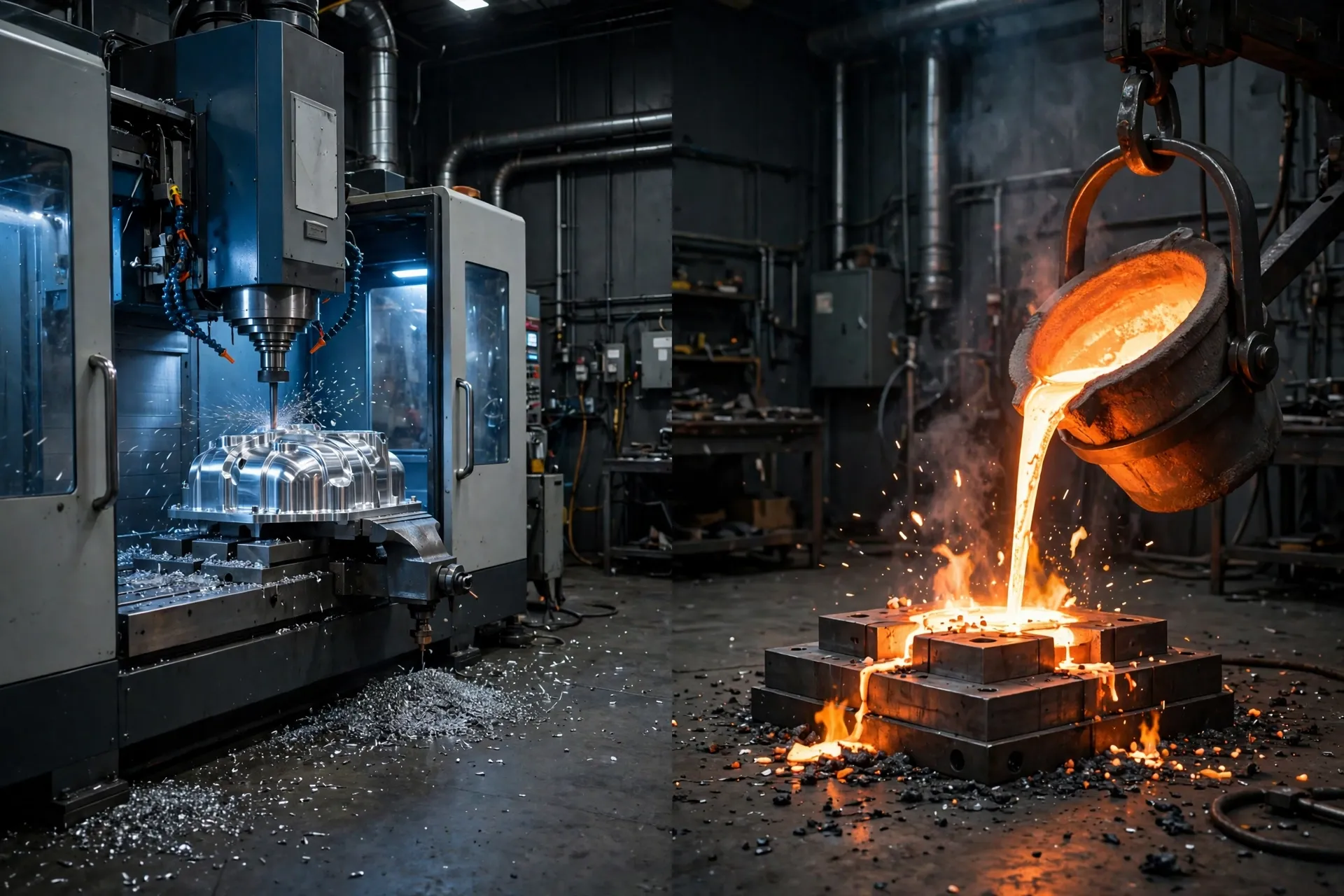
The short answer
If you need a small number of precise, complex parts — or parts in many different shapes — choose CNC machining. If you need thousands of identical, thin-walled metal parts at a low unit cost — choose die casting.
Most real projects are not either/or. Many parts are die-cast first and then CNC-machined for the features that need tight tolerances. That combination is where a supplier that does both processes, like Mulmic, saves you time: one drawing, one supplier, one quality check.
What is CNC machining?
CNC machining cuts metal away from a solid block, bar or plate with computer-controlled milling and turning. No mould is needed, so you can start with a single prototype and change the design quickly.
Best for:
Prototypes and low-volume production
Complex geometries, threads, holes and tight tolerances
Parts that change often during development
Aluminium, brass, copper, stainless steel and carbon steel parts
Typical industry-standard tolerances: ±0.05 mm for CNC-machined features is typical; tighter tolerances are possible on specific features, to confirm per drawing.
Typical materials: 6061 and 7075 aluminium, C36000 brass, C11000 copper, 304 / 316 stainless steel, 1045 carbon steel.
Typical surface finishes: anodizing, bead blasting, polishing, powder coating, plating, passivation.
What is die casting?
Die casting injects molten metal into a steel mould under high pressure. The mould costs more up front, but each part is fast to make, with good surface finish and thin walls.
Best for:
High-volume production — typically thousands of parts and more
Thin-walled housings, enclosures, heatsinks and brackets
Parts with consistent, repeatable shapes
Aluminium and zinc alloy parts
Typical industry-standard tolerances: ±0.1 mm for die-cast features is typical; features that need tighter control are finished by CNC machining after casting, to confirm per drawing.
Typical materials: ADC12 / A380 aluminium alloys, Zamak 3 zinc alloy.
Typical surface finishes: anodizing, powder coating, painting, plating, polishing.
CNC machining vs die casting at a glance
- Tooling cost: CNC machining — Low (no mould); Die casting — Higher (steel mould)
- Unit cost at low volume: CNC machining — Lower; Die casting — Higher
- Unit cost at high volume: CNC machining — Higher; Die casting — Lower
- Typical tolerance: CNC machining — ±0.05 mm (typical); Die casting — ±0.1 mm (typical)
- Best volume: CNC machining — 1 to a few thousand; Die casting — Thousands and more
- Design changes: CNC machining — Easy and fast; Die casting — Slower (mould change)
- Surface finish: CNC machining — Excellent, many options; Die casting — Good (often CNC-finished)
How to choose: 5 questions to ask
1. How many parts do you need?
Under a few hundred, CNC machining is usually the better choice. Over several thousand identical parts, die casting usually wins on unit cost.
2. How tight are your tolerances?
If a few features need ±0.05 mm or tighter, CNC machining — or die casting plus CNC finishing — is the way. Tell your supplier which dimensions are critical, and which are not.
3. How complex is the shape?
Thin walls, ribs and complex outer shapes suit die casting. Deep pockets, threads and precise bores suit CNC machining.
4. Which material do you need?
Aluminium works in both processes. Brass and copper are usually CNC-machined. Zinc is usually die-cast. If you are not sure, send your drawing — material choice should follow the part's function, not the other way round.
5. Will the design change?
If you are still iterating, start with CNC machining. Once the design is frozen and volume grows, move to die casting for the same part.
Can you combine both processes?
Yes — and for many housings, flanges and heatsinks, you should. A typical Mulmic workflow is:
- Die-cast the near-net shape — fast, repeatable, low unit cost at volume.
- CNC-machine the mating faces, bores and threads that need tight tolerances.
- Finish with anodizing, powder coating or plating to your specification.
- Inspect before shipment, and ship to Europe or the US.
This is also how prototype, low-volume and mass production connect: start with CNC prototypes, validate the design, then move to die casting when volume justifies the mould.
What Mulmic can make for you
Mulmic's core services are CNC machining and die casting, with stamping and sheet metal fabrication alongside, and injection moulding as a later-phase service. Typical applications include automotive parts, aerospace components, medical device parts, electronics housings, robotics parts and energy equipment.
Every part is made to your drawing. Send a 2D drawing or 3D model, and Mulmic will review it for manufacturability, confirm material, finish and tolerance per drawing, and quote prototype, low-volume and mass-production pricing.
FAQ
Is CNC machining or die casting cheaper?
It depends on volume. CNC machining is usually cheaper at low volume because there is no mould cost. Die casting is usually cheaper per part at high volume, once the mould cost is spread across thousands of parts. Exact pricing is confirmed per drawing.
What file formats should I send?
Send your 2D drawing (PDF / DWG) and 3D model (STEP / IGES) if you have them, with material, finish, tolerance and quantity noted. If a detail is still open, say so — Mulmic will confirm it with you before quoting.
What tolerances can Mulmic hold?
Typical industry-standard tolerances are ±0.05 mm for CNC machining and ±0.1 mm for die casting. Exact tolerances for your part are confirmed per drawing.
How long does a quote take?
Send your drawing and requirements to Nika Yan at nika@mulmic.com, or WhatsApp / WeChat +86 189 2946 9968. Lead time and MOQ are confirmed per drawing.
Do you ship to Europe and the US?
Yes. Mulmic serves customers in Europe and the US, with parts inspected before shipment.
Get a quote: Send your drawing to Nika Yan — nika@mulmic.com, Mobile / WhatsApp / WeChat +86 189 2946 9968. Mulmic Co., Ltd., Room 307, Zhufoling Road #105, Tangxia Town, Dongguan City, 523720, China. Monday–Saturday, 8:30–18:00.
Note: tolerances, materials and finishes in this article are typical industry-standard values. Exact specifications for your part are confirmed per your drawing.